This week we took a couple days away from the aid post to go to Ama Dablam base camp (hence the delay in our posts). Ama Dablam is over 22,000 feet and one of the most difficult mountains to summit in the world. Although several thousand feet lower than Mt. Everest, it is a favorite of mountaineers. We can see Ama Dablam from Pheriche on most days and it has become on of our favorites as well.
The usual trail to basecamp is from Pangboche (two towns lower), but a couple local guides told us if could be done from Dingboche in about three hours. If true this would save us a couple miles and the decent and then re-accent from Pangboche. Our map had a vague trail, and we figured we had nothing to lose but trying it.
We started after an early breakfast and the weather was perfect. Not a cloud in the sky, little wind, and traces of spring-like warmth. We set off towards dingboche and made short time across the ridge. Our first challenge was to find the bridge over the river on the other side of dingboche. This proved difficult. We spent about an hour just finding this bridge, which appeared dodgey (in the parlance of our kiwi mates) at best. Once over the river we were to follow a trail south then east. We found a trail that led over ice-packed snow, rocky moraines, and eventually up to a small settlement (house + rock fenced-yard). At this point we picked up a weak trail that continued to ascend towards the upper part of a steep rockfall. Aside from a few stray yaks, there were no other souls around. The trail weakened - appearing more and more as a yak path - and brought us over the rockfall. Here the trail evaporated. We weren't exactly lost, and we knew what direction to go, but had no great route available. We pressed on, ascending through budding juniper and dried cardamom until we hit a steep, loose rockfall. The trail long since lost, and not daring to traverse the loose rock or descend without a clear trail, we chose to scramble up to the "top." It took some effort and considerable balance we emerged above the loose stuff at the top of this rockfall. Incredibly, from here we discovered a new trail - marked clearly by cairns - that guided us over the rockfall. The way was riddled with large unstable boulders, but was mostly flat, so we thanked the trail gods for this turn of luck. Once across the glacial rock field, we followed the trail down into a rocky swale, out of the wind, and ate our peanut butter and jam and hazelnut sandwiches. The lunch spot afforded us the last clear views of amadablam for the day, as clouds were rolling in from the south, so we spent some time admiring view. We also consulted a map. :) Fortunately, we were more or less on-course and spotted a settlement that was on a connecting trail to amadablam basecamp. We descended into the settlement and re-ascended on a series of weak trails, finally, to the main trail to the basecamp. There were several people on the trail and the trail was well travelled and easy to follow...but by now the clouds had engulfed not only amadablam but us and the trail. The wind picked up and the temperature had dropped.
We were at a decision point. Do we retreat to Pengboche for the night, or with no visibility and an unclear duration of trekking to basecamp ahead of us press on? We had planned to make it base camp and spend the night in Pengboche, but the options seemed mutually exclusive after we had spent 5+ hours of hard trekking already and not really knowing what lay ahead toward the mountain.
We spotted a trekker up the trail, towards basecamp, that looked to be struggling so we decided to continue heading up - in part to help out if needed - and reevaluate in an hour. It was ~3p. Upon overtaking the trekker and inquiring about his health, we learned that he was struggling but ok and planning to spend the night in Mingbo. This is a small settlement near basecamp...but we had no idea that there was a place to stay there. Intrigued by the possibility of staying overnight (especially since we had been trekking for 6h and the weather had turned) we committed to continuing up. Sure enough, within 30min we arrived at a new lodge located directly beneath amadablam. The struggling trekker was part of a larger group of Aussies staying at the lodge and luckily there was one room left for us to stay in. We were elated to find this oasis and happily took some momos and Sherpa stew for dinner. The Aussie group was composed of two father-daughter pairs (roger and Annabelle + Richard and Sally), and we were quite impressed as the girls were perhaps 12 or 13 and appeared to be handling the trek quite well. We spent much of the evening chatting with them. One of the pairs had spent time in New England, including Boston, North Conway, Marblehead, and Stowe, VT. We lucked out too as the Trekkers had arranged for their cooks to prepare a birthday cake for their guide, sumday sherpa, and they shared the confection with us. Chocolate frosting never tasted so good!
We retired early that night but Hill had a hard time sleeping. By around midnight the sky had cleared and Hill actually spotted headlamps moving up the southwest ridge of amadablam - most likely from a team of climbers attempting to summit. It is common for such attempts to occur late in the night because this is when the weather is most favorable.
The next morning we were treated to absolutely breathtaking views of amadablam, with the sun rising behind her. After a breakfast of toast and eggs we headed over a small ridge to amadablam basecamp (only about a 15min walk) and spent another hour or so meandering up the main trail to camp I. There were climbers heading up that way with their gear and porters and we went as far as we could but eventually hit the snow line where more gear was required. Although it was difficult to peel ourselves away from this special place, we eventually returned to the lodge, gathered our gear, and began our descent. We chose to go through Pengboche and follow the main trekking route back up to dingboche and then to pheriche.
We parted ways with the Aussie group near Pengboche and began our ascent back into the khumbu. The views of the valley below pheriche were incredible though and filled with signs of spring. The weather was quite warm (in the 60s) and there were butterflies crossing our path and rhododendrons starting to bud around us. We took lunch in Somare - at the same place that we stopped on our way up in March - and made it to dingboche in time for the altitude lecture. By the time we arrived in pheriche we were thoroughly exhausted and satisfied with our excursion. Not a whole lot went as planned, but everything worked out in the end!
Friday, April 26, 2013
Wednesday, April 24, 2013
Arjun's Birthday
Today is Arjun's 24th birthday. Nepalis do not normally celebrate birthdays, but arjun was happy to oblige our need for tradition. Jeet made a carrot cake in the sun oven which we decorated with an egg white frosting and sprinkles. We also fashioned a new birthday cap out of some colored paper buried within the aid-post. The tip of the cap is adorned with an examination glove chicken. Hill and I secured some tallboy tuborgs to pair with the pizzas that Jeet made for dinner. Great night, for a great guy!
Nepalese Chains
There are a number of chain shops and lodges in Nepal. We found a Wal-mart in Kathmandu and a "Holiday" Inn in Dingboche, the town over from us. There appears to be a "Panorama" lodge in every town or settlement on the Everest Base Camp trekking route.
Samosas
Jeet made the most wonderful samosas today. These are one of our favorite regional foods and since we have left Atlanta, we do not have the Dekalb Farmers Market to get our samosa fix. We have yet to find good spicy samosas in Boston. I have tried to make them several times without achieving samosa nirvana or even a passable version. Today I very closely watched Jeet make them and even folded a few myself. Chris helped make the sauce. While Jeet doesn't measure much in exact amounts, below is the approximate recipe. It was incredibly simple compared to my previous attempts. Hopefully we can recreate them at home.
Dough:
Flour, water, and salt
Roll out thinly and cut into circles with bowl/cup
Filling:
Boiled potatoes, peeled and mashed
Onions
Salt
Curry powder
Optional peas, raisins, or lentils
Spicy tomato sauce:
Onions, sautéed in olive oil
Tomato sauce
Water with flour for thickening
Chili powder
Salt
Dough:
Flour, water, and salt
Roll out thinly and cut into circles with bowl/cup
Filling:
Boiled potatoes, peeled and mashed
Onions
Salt
Curry powder
Optional peas, raisins, or lentils
Spicy tomato sauce:
Onions, sautéed in olive oil
Tomato sauce
Water with flour for thickening
Chili powder
Salt
Tuesday, April 23, 2013
The meteor shower and the Jimmy Carter room
There was supposed to be a large meteor shower over the last few nights, but since the sky has been clouded and snowing, we haven't seen them yet. Tonight there was some promise of clearing so we joined Jim and Sarah (the Everest Extreme doctors) to watch the sky. Originally we had aspirations of climbing the ridge towards Dingboche for a better view, but cold and concern over descending in the dark convinced us to stay on the ground. We had bought some local rum to mix with coke or pineapple juice and had a mini celebration. If you have ever drank alcohol at altitude, you know that a little goes a long way not to mention that we don't drink often here, so we were all lightweights.
Sometime after dark, we went out to attempt to photograph to stars and mountains. It is beautiful on clear nights how the moonlight lights the snow on the surrounding mountains and the stars are more numerous an you can imagine. However, I have never been able to capture it very well on film despite my best efforts and long exposures. Tonight was no exception. (I suspect the rum didn't help.)
We were entertained by the local animals though. A couple of stags broke out of one of the yards and were going at each other for a good hour. This of course riled up Pumo and the other mountain dogs. To keep Pumo from barking and antagonizing the horses too much Chris found a rope to play tug of war with him with.
We stayed up until almost 1am which is nearly unheard of in the mountain towns that generally close up at 9pm. Jim and Sarah got locked out of the Himalayan Hotel and had to sleep in our extra room (aka the Jimmy Carter room). Many years ago, President Jimmy Carter made a trip to Pheriche and stayed in the HRA aid post. There is a photo with him and the clinic staff that year which is now yellowed with age hanging in the main room of the clinic. It was a fun night but a little painful the next day for everyone involved.
Sometime after dark, we went out to attempt to photograph to stars and mountains. It is beautiful on clear nights how the moonlight lights the snow on the surrounding mountains and the stars are more numerous an you can imagine. However, I have never been able to capture it very well on film despite my best efforts and long exposures. Tonight was no exception. (I suspect the rum didn't help.)
We were entertained by the local animals though. A couple of stags broke out of one of the yards and were going at each other for a good hour. This of course riled up Pumo and the other mountain dogs. To keep Pumo from barking and antagonizing the horses too much Chris found a rope to play tug of war with him with.
We stayed up until almost 1am which is nearly unheard of in the mountain towns that generally close up at 9pm. Jim and Sarah got locked out of the Himalayan Hotel and had to sleep in our extra room (aka the Jimmy Carter room). Many years ago, President Jimmy Carter made a trip to Pheriche and stayed in the HRA aid post. There is a photo with him and the clinic staff that year which is now yellowed with age hanging in the main room of the clinic. It was a fun night but a little painful the next day for everyone involved.
Sunday, April 21, 2013
Bearded Mountain Man
Chris is quite proud of his growth of facial hair over the past month. Hillary is not as impressed. We are taking a vote. What do you think? Should the beard stay or should it go?
Wednesday, April 17, 2013
The Housecall
It was a cold and snowy night when we got the call, and we were just finishing dinner. The aid-post's phone service was down, so the call from just over the ridge had been routed through Kathmandu to one of the teahouses in Pheriche; the owner of the teahouse came to the aid-post to inform us. There was a request for a housecall in Dingboche to see a patient with "severe AMS and gastroenteritis." Unsure of what exactly we would find, we loaded up our packs with an oxygen tank, iv fluids, dexamethasone (a steroid used in HACE), nifedipine (a blood pressure medicine also used in HAPE), and some other medications for vomiting and diarrhea.
Chris, Arjun, and I set out over the ridge in the dark. The path to Dingboche is steep, slippery, and hard to follow in the daylight. After dark, it was a real challenge. I led the wrong way up an even steeper yak path, and we had to traverse to get back on track. Luckily we have been walking the path every few days as part of a morning hike or on the way to our afternoon lectures in Dingboche. The falling snow looked like a meteor shower in our headlamps, and visibility became only a meter or so as we ascended into a cloud. On the other side of the ridge, we could barely make out the town lights but we eventually found the right tea house.
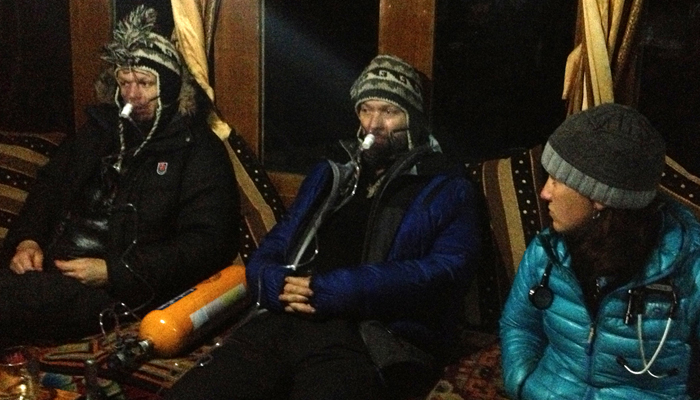
Rather than the expected patient with severe AMS, we found two patients with both HAPE (High Altitude Pulmonary Edema) and HACE (High Altitude Cerebral Edema). One guy could not walk straight and was breathing heavily, but his companion could barely respond, fell when standing, and had oxygen saturation of 31% (normal for here is 85%). He is probably our sickest patient yet and might not have made it through the night without intervention. He also had vomiting and diarrhea (likely bacterial gastroenteritis) that had gone untreated for the last 4 days. They both needed oxygen, medications, and evacuation. But we had only brought one oxygen tank.
At this point we had a choice. We could get a large team to carry both men and all their gear over the treacherous path we had just came. Or we could get another oxygen tank, more meds, and camp out with the patients overnight in Dingboche. We chose the latter. Fortunately, the patients' trekking group and guides were supportive, and two porters agreed to hike to the aid-post to retrieve more supplies: more oxygen, dexamethasone, and some other supplies. Chris and Penny arranged the provisions and sent the porters back with what we needed. The "ICU" was setup in the common room of the teahouse, with the patients in their sleeping bags and Chris and I under blankets provided by the teahouse owner. We was awake for most of the night checking the patients' vitals every couple of hours, and the porters worked in shifts to keep the patients' oxygen masks in place and to help them get to the bathroom when the diarrhea recurred which was almost hourly.
Both patients exhibited rather disturbing "periodic" breathing which is similar to sleep apnea. This breathing is irregular where the time between breaths gets longer and longer until they have a "missed breath" or stop breathing for 20-30 seconds. Then they usually gasp - usually waking themselves up and frightening anyone sleeping nearby. This is a pretty typical breathing pattern at altitude, but the worse patient was doing so at 50-60 breaths per minute (about 3 times normal). At home, I would have intubated him hours ago and let he ventilator take over. One of the medications we use to treat patients with HAPE is sildenafil, aka Viagra, which I don't use often. Although it sounds funny, sildenafil is used in pulmonary hypertension although most people know it for it much more marketed and ...um... sexier indication. Whether it was just time on oxygen or the sildenafil, this patient seemed to respond pretty well and his breathing improved.
Finally, dawn broke, and with it news that the helicopter would arrive shortly. The patients had both remained relatively stable through the night, although the worse-off patient was still measuring a meager blood oxygen saturation of 50% and struggling to walk straight. Along with the porters, we helped the two men to the helipad and saw them off.
The beautiful landscape before us belied the tragedy that we learned about upon our return to the aid-post in Pheriche. Chris and Penny filled us in on the bombings in Boston and we immediately sought to connect with our family and friends in Boston. Chris's parents were on the sidelines near the finish line that morning and his brother-in-law, Jay, was running the marathon. We were relieved to learn that Jay's pace was such that he crossed the line and had moved out of harms way (along with his parents, Julie, and Garry and Sue) minutes before the bombs went off. Not even a distance of 7400 miles can provide the perspective to make sense of such events. Our hearts go out to those affected in Boston.
Hill and Arjun taking a breather atop the ridge on the way to Dingboche. Dark and snowy, moments later we were engulfed in a dense fog.
The two patients sharing a tank of oxygen while we wait for more supplies to arrive. The patient on the left has a mohawk hat...and a real mohawk underneath. The slightly bluish guy in the middle was in critical condition.
Hill, Arjun, and a porter helping the critical patient to the helicopter the next morning.
Chris, Arjun, and I set out over the ridge in the dark. The path to Dingboche is steep, slippery, and hard to follow in the daylight. After dark, it was a real challenge. I led the wrong way up an even steeper yak path, and we had to traverse to get back on track. Luckily we have been walking the path every few days as part of a morning hike or on the way to our afternoon lectures in Dingboche. The falling snow looked like a meteor shower in our headlamps, and visibility became only a meter or so as we ascended into a cloud. On the other side of the ridge, we could barely make out the town lights but we eventually found the right tea house.
Rather than the expected patient with severe AMS, we found two patients with both HAPE (High Altitude Pulmonary Edema) and HACE (High Altitude Cerebral Edema). One guy could not walk straight and was breathing heavily, but his companion could barely respond, fell when standing, and had oxygen saturation of 31% (normal for here is 85%). He is probably our sickest patient yet and might not have made it through the night without intervention. He also had vomiting and diarrhea (likely bacterial gastroenteritis) that had gone untreated for the last 4 days. They both needed oxygen, medications, and evacuation. But we had only brought one oxygen tank.
At this point we had a choice. We could get a large team to carry both men and all their gear over the treacherous path we had just came. Or we could get another oxygen tank, more meds, and camp out with the patients overnight in Dingboche. We chose the latter. Fortunately, the patients' trekking group and guides were supportive, and two porters agreed to hike to the aid-post to retrieve more supplies: more oxygen, dexamethasone, and some other supplies. Chris and Penny arranged the provisions and sent the porters back with what we needed. The "ICU" was setup in the common room of the teahouse, with the patients in their sleeping bags and Chris and I under blankets provided by the teahouse owner. We was awake for most of the night checking the patients' vitals every couple of hours, and the porters worked in shifts to keep the patients' oxygen masks in place and to help them get to the bathroom when the diarrhea recurred which was almost hourly.
Both patients exhibited rather disturbing "periodic" breathing which is similar to sleep apnea. This breathing is irregular where the time between breaths gets longer and longer until they have a "missed breath" or stop breathing for 20-30 seconds. Then they usually gasp - usually waking themselves up and frightening anyone sleeping nearby. This is a pretty typical breathing pattern at altitude, but the worse patient was doing so at 50-60 breaths per minute (about 3 times normal). At home, I would have intubated him hours ago and let he ventilator take over. One of the medications we use to treat patients with HAPE is sildenafil, aka Viagra, which I don't use often. Although it sounds funny, sildenafil is used in pulmonary hypertension although most people know it for it much more marketed and ...um... sexier indication. Whether it was just time on oxygen or the sildenafil, this patient seemed to respond pretty well and his breathing improved.
Finally, dawn broke, and with it news that the helicopter would arrive shortly. The patients had both remained relatively stable through the night, although the worse-off patient was still measuring a meager blood oxygen saturation of 50% and struggling to walk straight. Along with the porters, we helped the two men to the helipad and saw them off.
The beautiful landscape before us belied the tragedy that we learned about upon our return to the aid-post in Pheriche. Chris and Penny filled us in on the bombings in Boston and we immediately sought to connect with our family and friends in Boston. Chris's parents were on the sidelines near the finish line that morning and his brother-in-law, Jay, was running the marathon. We were relieved to learn that Jay's pace was such that he crossed the line and had moved out of harms way (along with his parents, Julie, and Garry and Sue) minutes before the bombs went off. Not even a distance of 7400 miles can provide the perspective to make sense of such events. Our hearts go out to those affected in Boston.
Hill and Arjun taking a breather atop the ridge on the way to Dingboche. Dark and snowy, moments later we were engulfed in a dense fog.
The two patients sharing a tank of oxygen while we wait for more supplies to arrive. The patient on the left has a mohawk hat...and a real mohawk underneath. The slightly bluish guy in the middle was in critical condition.
Hill, Arjun, and a porter helping the critical patient to the helicopter the next morning.
A view from the valley floor in Dingboche shortly after the helicopter departed.
Sunday, April 14, 2013
Where are we?
We realized recently that a map of the Everest region might be helpful for putting our trip and excursions in perspective. Below is a rough map of the area. We are in Pheriche, just right of center in the map. We flew from Kathmandu into Lukla (located center bottom) and trekked north/northeast. We stayed a night in Munjo (not on the map) and two nights in Namche Bazar. We then went north into Khumjung to visit the clinic there and proceeded to Tengboche for a night. From Tengboche we went directly to Pheriche. Pheriche's sister town in Dingboche, which has a French Bakery and many teahouses. We give altitude lectures in Dingboche every Monday, Wednesday, and Friday so we visit there quite often - it is about a 30-40 min hike over a high ridge (the photos of the mountain dogs were taken at the top of this ridge). Amadablam is a beautiful mountain that overlooks Digboche and Pheriche and appears in many of our photos. The word amadablam means "mother's necklace" and refers to the bit of mountain separated from and lower than the main peak. The main peak is also flanked by two ridges. The locals view these features as the welcoming arms of a mother with the separated bit like a traditional necklace/pendant worn by sherpa mothers.
Since arriving in Pheriche, Hill and I have spent a couple of nights in Chhukung (center right) and hiked to the base camp of Island Peak (far right, Pareshaya). Chris and Penny have made an excursion to the Everest Base Camp (upper right), spending nights in Lobuche and Gorak Shep, as well as to Kalapathar. Whereas many trekkers and all climbers put great weight on arriving at Everest Base Camp (EBC), the views from EBC are not that impressive. The views from Kalapathar on the other hand (according to Hill) are incredible. Hill and I will be heading there in a couple of weeks when the weather is a warmer and EBC is more busy with climbers preparing for their summit attempts. Whereas the peak trekking season is March - early May, the peak climbing season is from April - early June, so for the first part of our stay in Pheriche EBC was nearly deserted. Climbing groups are arriving nearly daily now, and the party at EBC is getting into full swing.
Also, a link to a google map of the region. Make sure the "terrain" data is shown for the best images.
Happy New Year!
Today is the Nepali/Hindu New Year. We celebrated New Years Eve last night by inviting the Extreme Everest doctors (Sara and Jim) over to the HRA Clinic for some drinks. We had found some Nepali rum which we mixed with either pineapple juice or Coke. We also had some whiskey of Chris and Penny's, and Sara and Jim brought some Pimm's and lemonade which tastes a little like sangria. We must have been thinking tropical. Jeet and Arjun joined the fun, and we stayed up until almost 10:30 pm around the yak dung fire which is a record.
Possibly more amazing, we awoke to go on a morning hike at 6:30 am before breakfast. Then, after breakfast, we went on an even more ambitious hike to 16,600 feet (5070 meters) which was 2,600 feet above Pheriche (800 meters).
We welcomed in the Nepali/Hindu year 2070.
At the pinnacle of our climb on New Year's Day. Amadablam is in the background.
Chris, Hill, Jeet, Arjun, Chris, and Penny enjoy some new year's eve libations.
Looking down the valleys from the height of our climb (~16.6k ft above sea level) . Pheriche is in the valley on the right.
Possibly more amazing, we awoke to go on a morning hike at 6:30 am before breakfast. Then, after breakfast, we went on an even more ambitious hike to 16,600 feet (5070 meters) which was 2,600 feet above Pheriche (800 meters).
We welcomed in the Nepali/Hindu year 2070.
At the pinnacle of our climb on New Year's Day. Amadablam is in the background.
Chris, Hill, Jeet, Arjun, Chris, and Penny enjoy some new year's eve libations.
Looking down the valleys from the height of our climb (~16.6k ft above sea level) . Pheriche is in the valley on the right.
Saturday, April 13, 2013
Clear days
The weather is starting to change - this is the second day in a row that we have not had snow or fog roll into the valley. Up to this point it was nearly like clockwork, with the clouds engulfing Pheriche around 4pm for about 4 hours. In addition, the outside thermometer measure nearly 12 degrees C today...which is about 55F and feels downright balmy! The result of no fog in the evenings is that we get spectacular views of Amadablam and the other peaks around the valley at sunset. These shots dont quite do the views justice, but are breathtaking nonetheless.
Looking up the valley, from a spring, with the Panorama and Himalayan Hotel teahouses in the mid-ground.
Amadablam in all her glory close to sunset:
Looking up the valley, from a spring, with the Panorama and Himalayan Hotel teahouses in the mid-ground.
Amadablam in all her glory close to sunset:
Subscribe to:
Posts (Atom)